
Keyboard Variants
PolyKybd ships in two hardware variants. They run one firmware codebase, so a feature added to the keyboard lands on both at once.
split72 vs split42
Section titled “split72 vs split42”| split72 | split42 | |
|---|---|---|
| Keys | 72 | 42 |
| Footprint | PolyKybd full-size split | CRKBD / Corne 42-key |
| RGB matrix | Yes (72 LEDs) | No |
| Pointing device | Cirque trackpad | No |
| Status OLED | 128×64 | 128×32 |
| Per-keycap OLEDs | 72×40 px monochrome | 72×40 px monochrome |
| Build target | polykybd/split72 |
polykybd/split42 |
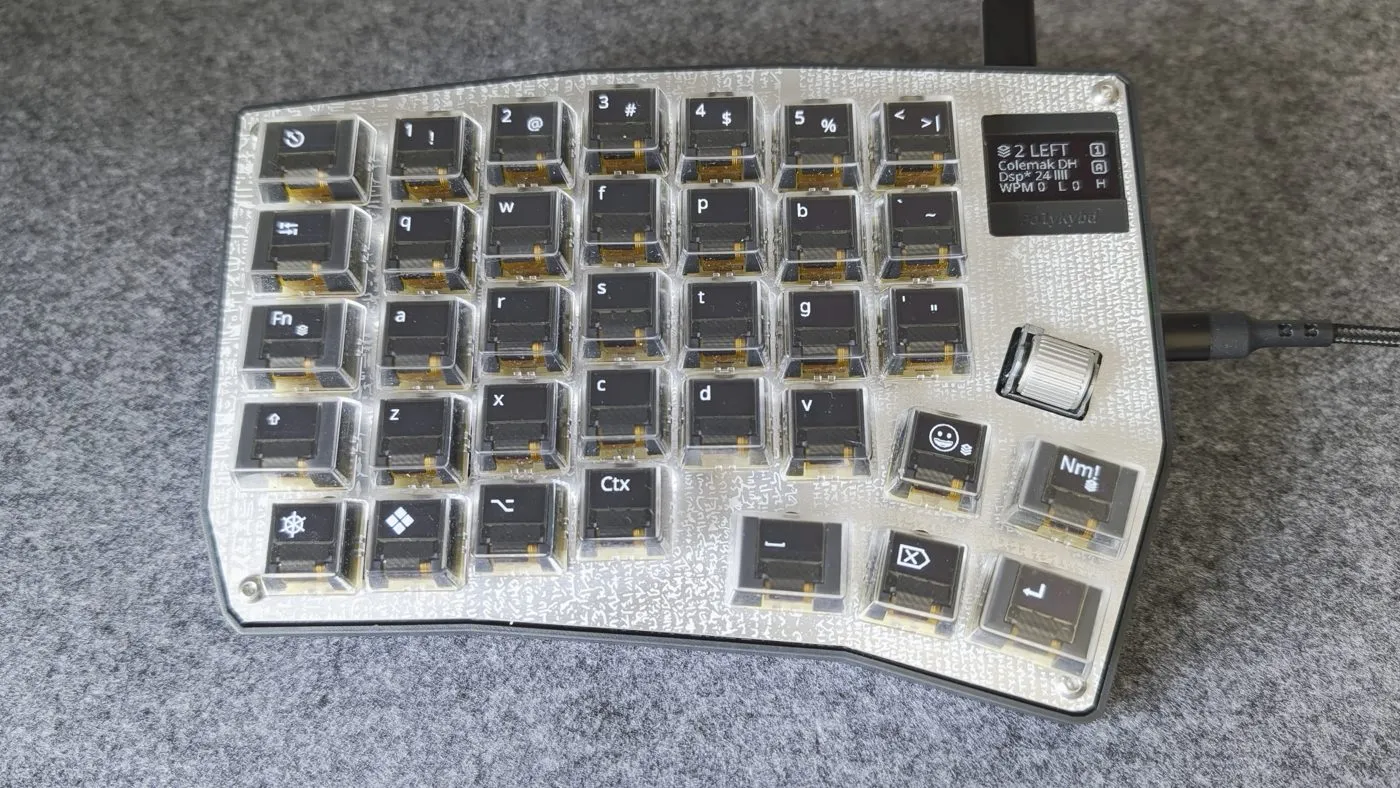
A split72 half — 36 keys, the 128×64 status OLED (here naming the active layout, Colemak DH), and a rotary encoder fitted in the expansion slot:
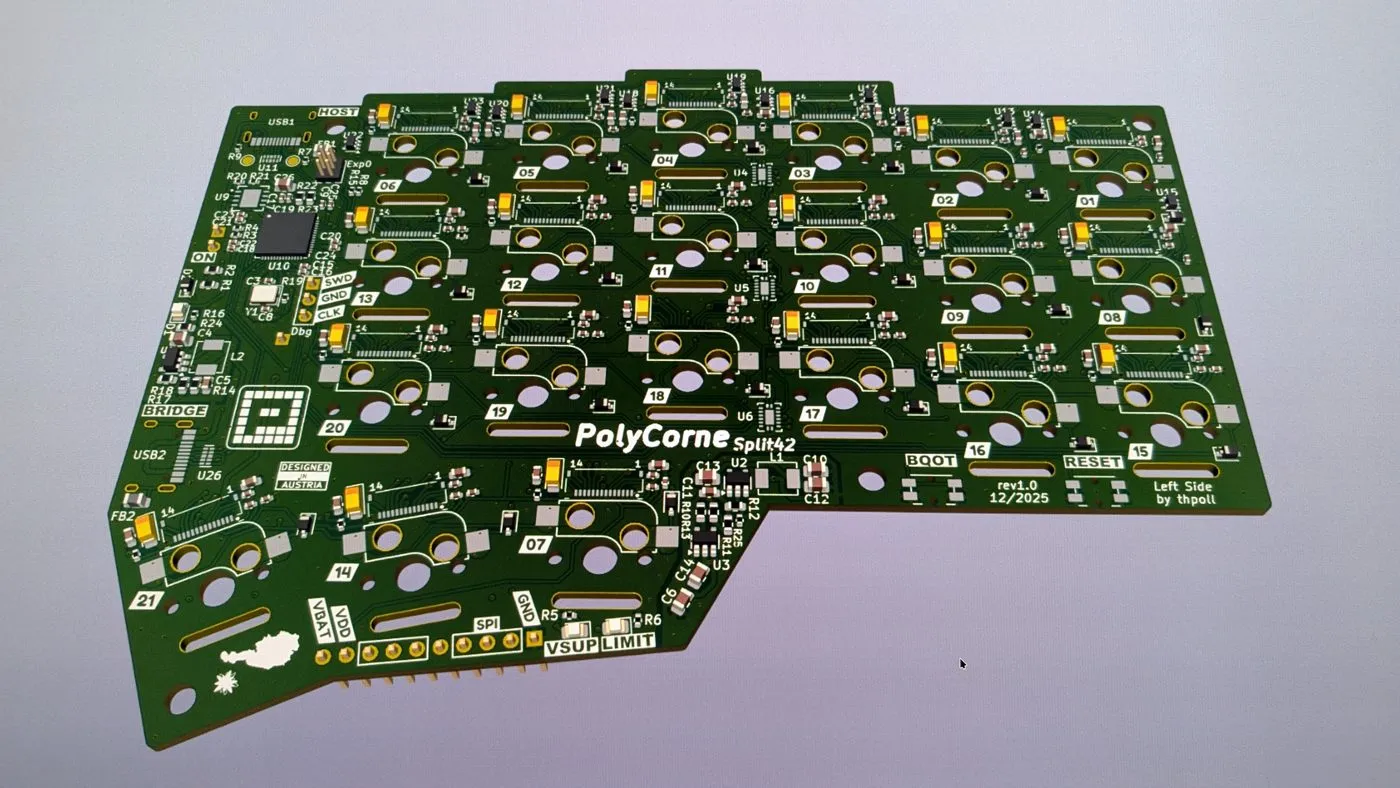
The split42 board, which carries 21 keys per half and no RGB or pointing device (KiCad render of
the PolyCorne Split42 rev1.0 left side):
One shared keymap
Section titled “One shared keymap”All behaviour lives in the keyboard-level poly_keymap.c (compiled for both variants via
rules.mk’s SRC): rendering, HID/overlay handling, language selection, idle/suspend, split-sync
glue, the firmware-update state machine, and the QMK *_user / *_kb callbacks.
Each variant’s default keymap file is data only — it holds the keymaps[] array, the
encoder_map[], and (on RGB variants) the LED config:
keyboards/polykybd/├── poly_keymap.c ← shared logic, both variants├── split72/│ └── keymaps/default/keymap.c ← split72 data only└── split42/ └── keymaps/default/keymap.c ← split42 data onlyVariant differences resolve at compile time: polykybd.h includes the active variant header
(selected by QMK’s -DKEYBOARD_polykybd_<variant>), and RGB_MATRIX_ENABLE /
POINTING_DEVICE_ENABLE guard the RGB and trackpad code paths.
Building a specific variant
Section titled “Building a specific variant”The build target selects the variant:
qmk compile -kb polykybd/split72 -km default# orqmk compile -kb polykybd/split42 -km defaultSee Firmware Development for the full toolchain setup.