

Context-Aware Overlays
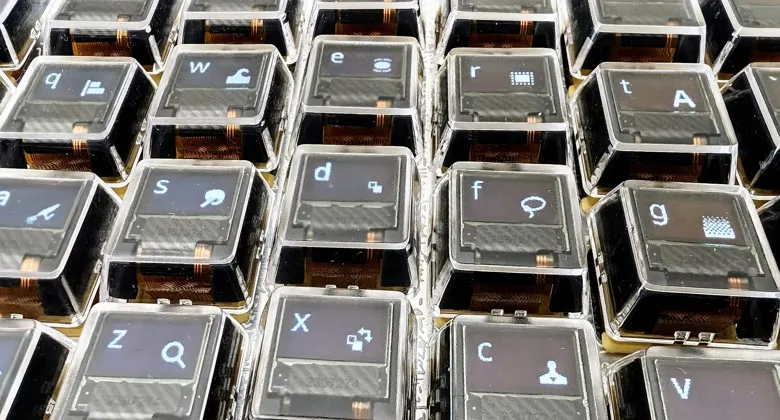
The signature PolyKybd feature: every key’s OLED shows an image (“overlay”) that matches whatever app you’re currently in. Switch from your browser to your editor and all 72 keycaps re-label themselves to that app’s shortcuts, with no action from you.
Overlays are driven by PolyKybdHost — the keyboard on its own shows the static legends baked into the firmware; the host is what makes them dynamic.
How it works
Section titled “How it works”- PolyKybdHost watches which window is focused on your computer.
- When the active app changes, it looks up the overlay set for that app and pushes the keycap images to the keyboard over USB HID (compressed, so a full re-label is quick).
- The master half decompresses the images into its display memory and relays them to the slave half over the split link, so both hands show the same thing.
Modifier variants
Section titled “Modifier variants”An overlay isn’t a single image per key — each key stores 16 variants, one for every combination of Ctrl, Shift, Alt and GUI (Command on macOS, Win elsewhere). Hold a modifier and the keycaps update to show what each key does with that modifier down, so a shortcut layer is visible before you commit to it.
What you need
Section titled “What you need”- PolyKybdHost running on the machine you’re typing on (or relayed from another machine — see Multi-Machine Setup).
- An overlay set for the app. PolyKybdHost ships overlays for the apps listed below, and adding one is a plain image plus a one-line mapping entry — Create App Overlays walks through it.
Which apps are covered
Section titled “Which apps are covered”These ship with PolyKybdHost and work as soon as it is running — nothing to install or configure.
| Apps | |
|---|---|
| Browsers | Chrome, Chromium, Edge, Brave, Vivaldi, Opera, Arc |
| Web apps (by URL) | GitHub, GitLab, Jira, Confluence, Bitbucket, Google Docs, Miro, Notion, Outlook on the web |
| Office & documents | Word, Excel, PowerPoint, Outlook, LibreOffice Writer / Calc / Impress |
| Creative | Photoshop, Illustrator, After Effects, Premiere Pro, DaVinci Resolve, GIMP, Krita, Inkscape, Figma |
| Development | VS Code, Visual Studio, JetBrains IDEs (IntelliJ, PyCharm, CLion), Sublime Text, Notepad++, KiCad PCB Editor |
| Notes | Obsidian, Notion |
| Communication | Slack, Discord, Teams, Zoom |
| System (Windows) | Explorer, Task Manager, Notepad, Calculator, Paint, Paint.NET, WordPad, Sticky Notes, Photos, Snipping Tool, Sound Recorder, the lock screen |
| Terminals & transfer | PuTTY, WinSCP |
A few entries are narrower than the app name suggests: KiCad covers the PCB Editor window specifically, and Notion appears twice because the desktop app and the web version are matched separately. Sound Recorder also answers to its Windows 10 name, Voice Recorder — same app, same keycaps.
Same app, different platform
Section titled “Same app, different platform”Which shortcuts an app uses depends on the platform it runs on: Sublime Text binds Cmd+P on
macOS and Ctrl+P on Windows and Linux. A single set of artwork therefore can’t be right
everywhere, so where an app has per-OS overlays the host picks the one matching your OS —
Cmd artwork on macOS, Ctrl artwork elsewhere — with nothing to configure.