

Idle & Burn-in Protection
OLED pixels that show the same legend for hours can burn in. To prevent that, PolyKybd moves through a few states while you’re away and wakes instantly the moment you come back.
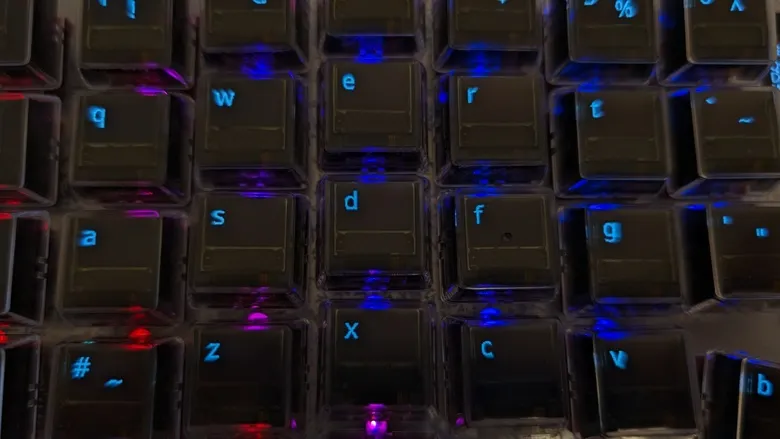
The idle sequence
Section titled “The idle sequence”- Awake — normal, full-brightness legends.
- Fade — after the idle timeout (2 minutes unless you change it) the keycaps dim.
- Idle — the displays run an anti-burn-in animation (see below).
- Off — after 20 minutes without a key press the keycaps switch off entirely.
Any key press wakes them — and if the optional light sensor is fitted, so does reaching toward the board.
How long before it idles
Section titled “How long before it idles”How long the keyboard waits before it starts fading is a setting on the board — one of six fixed choices: 15 sec · 30 sec · 45 sec · 1 min · 2 min · 5 min.
2 minutes is the default, and it is what every keyboard did before this setting existed — so a board you never touch behaves exactly as it always has.
Set it in any of three places:
- On the keyboard — a key on the settings layer, behind More… (see
the settings layer), next to the idle-style key. It shows a small
clock face over the current value, so
2minon the keycap is the setting. - Tray menu — right-click the PolyKybdHost tray icon → Idle Display → Idle After.
- Command line —
polyctl idle-timeout 30sec(or15sec,45sec,1min,2min,5min; with no argument it prints the current one).
Like the style, your choice is saved on the keyboard and survives a reboot and a reconnect.
Idle styles
Section titled “Idle styles”| Style | What it does |
|---|---|
| Pulse | Each key gently “breathes” its brightness out of phase with its neighbours. The lit pixels don’t move — simple, and the legend stays glanceable. The default on the split42. |
| Jitter | Keeps the breathing, but each key also relocates its legend to a fresh random spot whenever its own pulse dims it to black. The lit pixels migrate per key, so no pixel stays lit in one place. |
| Eden | A full-screen screensaver: a procedural “comet field” streams across all keycaps, with the key legend drifting over it as a dim overlay. Pretty rather than glanceable — the moving pixels give the strongest burn-in protection. The default on the split72. |
Pulse and jitter keep the dimmed legend readable so you can glance down and resume typing; jitter adds stronger burn-in protection by moving the lit pixels. Eden trades that glanceability for a full moving picture — it’s a screensaver, so the pixels never rest in one place. Any key press dismisses it instantly.
Eden dims its drifting legend by lighting every other row rather than every row. Since firmware 0.17.3 that stripe pattern shifts as the legend moves, so the dimming itself no longer favours one set of rows for the life of the board.
Choosing a style
Section titled “Choosing a style”- On the keyboard — a key on the settings layer, behind More… (see
the settings layer). It names the active style rather than
its own function —
IDLE:on the first line, the current style on the second — so the keycap answers what is this set to without being pressed. Each tap moves to the next style. - Tray menu — right-click the PolyKybdHost tray icon → Idle Display → Pulse, Jitter, or Eden.
- Command line —
polyctl idle-style pulse(orjitter,eden).
Your choice is saved on the keyboard and persists across reboots.